Murder at Christmas
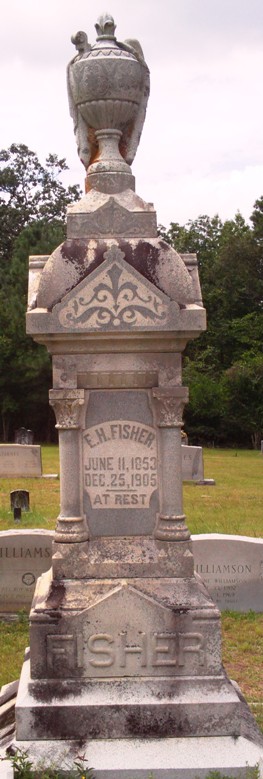
My great uncle Hubert Fisher was brutally murdered on Christmas Eve 1904, although the date of death on his tombstone is Christmas Day. Hubert (whose full name was Eugenius Hubert Fisher, Jr.) was known locally as E. H. Fisher, was single, childless, and one of the wealthiest men in his part of South Carolina. He lived in Salley (Aiken County), South Carolina, a bustling railroad town, and owned and operated a general store that sold everything anybody needed in this agricultural community. He loaned money to many people, sold goods on account to many customers, and bought and sold real estate many times. The letterhead from his mercantile business reads: “E. H. Fisher – Dealer in Wagons, Buggies, Harness, Saddlery, Whips and Lap Robes. Furniture, Hardware and General Merchandise. Heavy Groceries and Fertilizers & Specialty.” In the 1900 census, he gave his occupation as “capitalist.”
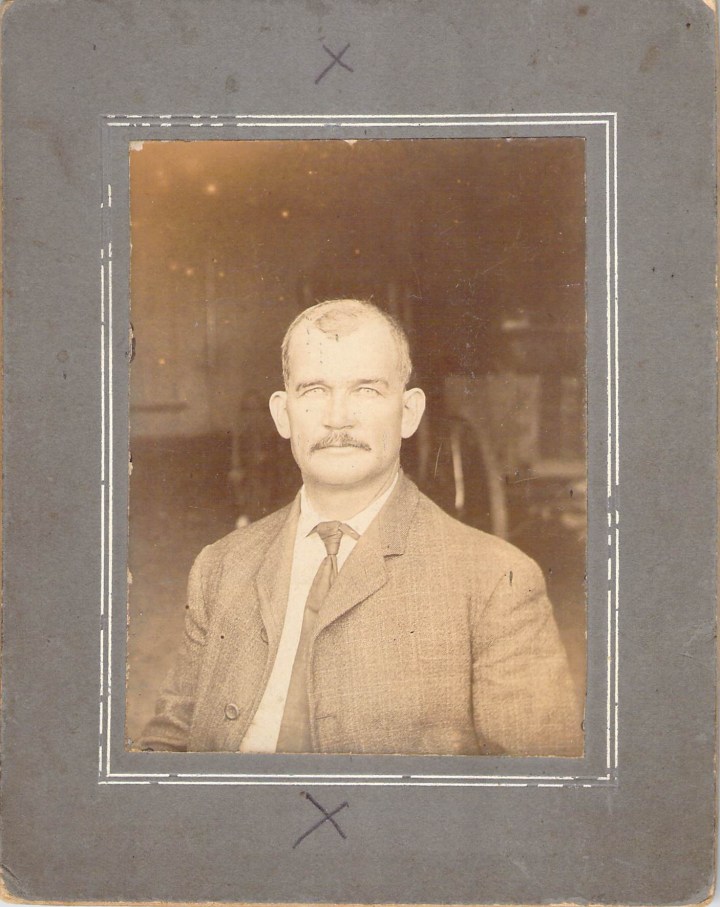
This is the only known photograph of Hubert, in what looks to be a store with a wagon or cart in the background:
The Story
The story of the murder and the hunt for Hubert’s killers is told in newspaper coverage of the day —
The State newspaper, December 27, 1905, page 1, column 5, 4:
HUBERT FISHER KILLED BY AN UNKNOWN HAND. Wealthy Aiken County Farmer Shot from a Window
TWO NEGROES IN PENITENTIARY – Christmas Week in South Carolina marked by Various Bloody Tragedies.
Special to The State.Aiken, Dec. 26. Hubert Fisher, a prominent and well to do merchant of Salley, in this county, was shot and killed by unknown parties, supposedly negroes, on the place of Mr. John William Brown, across Edisto River about half way between Aiken and Salley, on Sunday night.
Sheriff Raborn was notified by telegram from Salley and he and Coroner Owens left by private conveyance yesterday. They have not returned as yet. Very little of the details can be learned here. Parties from Salley in Aiken today say that Mr. Fisher was shot by parties unknown while he was attempting to arrest a negro who had a mule that had been stole from him. From these sources it was learned that Mr. Fisher had arrested one negro, who, it was stated, had taken the mule and who told him that the animal was then in the possession of Barney Dunbar, on Mr. Brown’s place. Mr. Fisher and a constable then went in search of Dunbar, found him at his house and arrested him. While Fisher and the negro were arguing about the mule someone inside the house shot Fisher twice with a shotgun. The first shot almost tore his arm off and the second tore his breast open. Mr. Fisher died while he was being carried to his home in Salley shortly after the shooting. The party who did the shooting is said to have escaped. Sheriff Raborn was asked to bring bloodhounds, but there are none here.Mr. Fisher was about 35 years of age. He was unmarried and lived with his mother and a sister. He is reported to be worth about $50,000, having amassed a fortune by hard work and attention to business.
NEGROES IN PENITENTIARY PROTEST THEIR INNOCENCE The negro Barney Dunbar and his father-in-law, Jim Williams, were brought to Columbia and placed in the penitentiary yesterday morning for safekeeping. They were seen yesterday afternoon and both were asked for a statement. Both of them talked readily and while apparently intensely in earnest, they both talked disconnectedly in telling their side of the story. The negroes are locked in cells in the prison building. They occupy separate cells in the same tier and are not allowed to hold any communication. It was dark when the reporter stopped at the door of Barney Dunbar’s cell and it was impossible to get a good view of his face. Dunbar said that he went to his house about 11 o’clock on the night of the shooting and his wife told him that Capt. Black and Mr. Fisher had been there to see him and had left word that they would be back Wednesday morning. Soon after his arrival at his home, Jesse Johnson, a negro “outlaw” as he expressed it, came in with a double barrel shotgun and took a seat. Dunbar said that he had only a slight acquaintance with Johnson. While Johnson was still there Mr. Fisher and Capt. Black returned and placed Barney under arrest, tying his hands with a rope. Mr. Fisher was outside the house and came in at the same moment that the firing commenced and the negro said that it was behind his back and he could not tell who was doing the firing, though he judged from the sound of the weapon that Mr. Fisher shot once. He also thought there must have been several others shooting but said he did not know who they were and if there was anybody else in the house he did not know they were there nor who they were. It was his opinion that the others were outside and opened the windows to shoot. He said that even with his hands tied he managed to get hold of the musale [sic] of a gun which he thinks was Johnson’s but he could not see the man, as he was around a corner of the wall. Capt. Black, he said, also had hold of the same gun with one hand and with the other he reached around the corner, and, placing his pistol almost against the unknown man, fired. Whether the shot took effect or not he did not know. Dunbar affirmed and reiterated his innocence of any connection with the killing as an accessory or otherwise, and in proof of this he said that when it was seen that Mr. Fisher was growing weak from loss of blood Capt. Black untied Barney and that he hitched his mule to a buggy and went for the doctor three miles away. While on his way to the home of the doctor, Barney says, that five negroes came out of the woods, and in an attempt to stop him they caused the mule to run away, smashing the buggy, throwing him out and dragging him several hundred yards. He could not recognize any of the men and did not know why they wanted to stop him. After he had stopped the mule he mounted and rode the rest of the way and delivered his message to the doctor, after which he returned and, according to his account, aided in ministering to the wounded man. Dunbar seemed much disturbed by his situation and inquired anxiously as to what would be done with him here and if he would be protected. When assured that he would be, he expressed a devout hope that it might be so. Jim Williams is much older than Dunbar and is not as smart. He also repeatedly declared his innocence of the entire affair and said that he was at home asleep when the shooting is said to have taken place. Williams lives about three miles from Dunbar and says that he was awakened by Bub Dunbar, a brother of Barney, running excitedly to Williams’ house about 12 o’clock and calling to him to get up, that “they were shooting Barney.” Williams says that he arose and started to Barney’s house but stopped at the house of a neighbor about half way there and while at this house changed his mind and decided to go by Barney’s house as he was afraid. Williams is about 46 years of age and Dunbar is about [illegible].
From The State (Columbia, SC) Sunday July 14, 1907, part I, page 2:MIDDLETON NEGRO WAS IDENTIFIED.Suspect Under Arrest Will Be Brought Back and Tried for Salley Murder.
The negro, under arrest at Middletown, N. Y., charged with the murder of E. H. Fisher, a prominent citizen of Salley, in Aiken County, has been positively identified as Fred Dunbar and yesterday afternoon Chief W. H. Davis of Salley, who has worked hard in tracing the negro, left for Albany, N. Y., where he goes with a request for requisition papers.
Dunbar and a negro named Jim Williams killed Mr. Fisher, December 24, 1905. The latter is under sentence of death for the crime and is to be hanged Next Friday, July 19, unless the governor grants a respite, which he now has under consideration.
Dunbar was identified by a former South Carolinian and Chief Davis sent his assistant, Burt Culbertson, to Middletown to look into the case. The telegram settles the matter, and unless Gov. Hughes of New York refuses the requisition, Dunbar will be brought back to this State and tried.
This is the second South Carolina criminal caught within the past few months in Middletown, N. Y., the other being a young white man wanted for forgery in Greenwood county.
from the Washington Herald newspaper (Washington, D.C.) Monday July 29, 1907, page 1, column 4:HOPE TO IDENTIFY NEGRO. Middletown, N. Y., July 28 – In the effort to identify William Wagner, a colored man, now in the orange County jail, as Fred, alias “Love” Dunbar, the murderer of E. Hubert Fisher, a merchant of Salley, S. C., Mayor George Sawyer, T. K. Livingstone, and W. H. Keel, citizens of Salley, came to Middletown to-day as representatives of Gov. Ansel, of South Carolina. The murder was committed on December 24, 1905.
Hubert’s Family and Me
Hubert was born on either June 11, 1853 (the date on his tombstone) or May of 1856 (according to the 1900 census). and was one of at least 6 children of Eugenius Hubert Fisher, Sr. The 1900 census, taken just 4 years before Hubert’s death, shows him living with his sister Jennie in Salley, SC. The newspaper account of his death says that Hubert was living with his mother and a sister at the time of his death. However, Hubert’s mother (Ada Cooper Henry) had died in West Virginia several years earlier. It is possible that the “mother” in the newspaper story was actually his recently-widowed older sister Bertine.
Hubert died without a will, leaving a very large estate. His estate administration papers on file in Aiken County reveal that he was survived by three sisters – Jennie (who shows up in his household in the 1900 census), Bertine and Ella, as well as the children of 2 other predeceased siblings. Hubert’s estate was therefore split 6 ways, among the following heirs:
-
Bertine Howard Fisher Jeffcoat
-
Jennie (Janie) L. Fisher
-
Mrs. Ella (Fisher) Corbitt
-
Children of Mrs. Emma S. D. (Fisher) Pickering (predeceased sister)
-
Children of Mrs. Maud M. (Fisher) Jordan (predeceased sister)
-
Gertrude Gardner, a minor under age 14, who Hubert brought into his household and treated as a family member. The other heirs agreed for Gertrude to have an equal share in Hubert’s estate. Gertrude is listed as “adopted daughter” in the 1900 census listing for Hubert’s household.
My great grandmother Bertine Howard Fisher married Paul Donald Jeffcoat (1847-1895). Together they had 14 children, 13 of whom lived to adulthood. Their 5th child was my grandfather Otis Allen Jeffcoat.
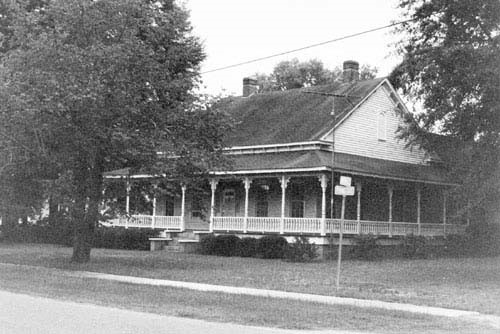
Unanswered questions
My research on Uncle Hubert is ongoing and unfinished. Answers to these questions have so far eluded me:
- How did Hubert, Jennie and Bertine come to live in Aiken County, South Carolina? Evidence to date suggests that they were born and raised in Monongalia County, Virginia (later West Virginia), but the evidence is conflicting. Their parents lived, died and were buried in Monongalia County. However, all of Hubert’s predeceased siblings left children in Aiken County or nearby counties.
- What happened to the murderers (Fred Dunbar and Jim Williams)? Were they indebted to Hubert?
- When was the railroad serving Salley?
- Would a timeline be helpful?
Hubert’s Tombstone
 Murder, Massacre & Mayhem in My Family
My Great Grandmother was Mary Ella Fisher born 12-28-1850 and was married to Joseph p Corbett. A cousin of my .g Grandfather Olin Tom Corbett invited us up to The chitlin Strut. He carried us to places of family members. very informative.
LikeLike